
Grauer’s gorillas are one of the four subspecies of gorillas and one of the two that the Dian Fossey Gorilla Fund works to protect. They are found only in the eastern part of the Democratic Republic of the Congo. Unfortunately, over the past three decades, their population has declined by more than 60 percent, placing them at very high risk of extinction. Today, Grauer’s gorillas are critically endangered and have been named one of the world’s 25 most endangered primates.
Because of the dire need to enhance conservation efforts, the Fossey Fund partnered with local communities in 2011 to start the Nkuba Conservation Area, a community conservation forest that covers about 2,400 square kilometers and holds one of the largest remaining populations of Grauer’s gorillas.

Most Grauer’s gorillas live outside of national parks.
Trackers follow unhabituated groups
Our work with Grauer’s gorillas mirrors what we do in Rwanda with their close cousin the mountain gorillas – daily protection and research. But with one significant difference – these gorillas are not habituated to the presence of humans, which means we follow their trail, usually one or two days behind where they have passed. But just because we can’t see them directly, doesn’t prevent us from gathering valuable information on their habitat requirements, diets and ranging patterns. Little is known about Grauer’s gorilla ecology and so these studies are invaluable for understanding them and their conservation needs.
Following these groups is not easy. It requires strong physical endurance and excellent orientation in dense forest. Our field teams rotate in and out, camping in the forest during their two- to three-week shifts.
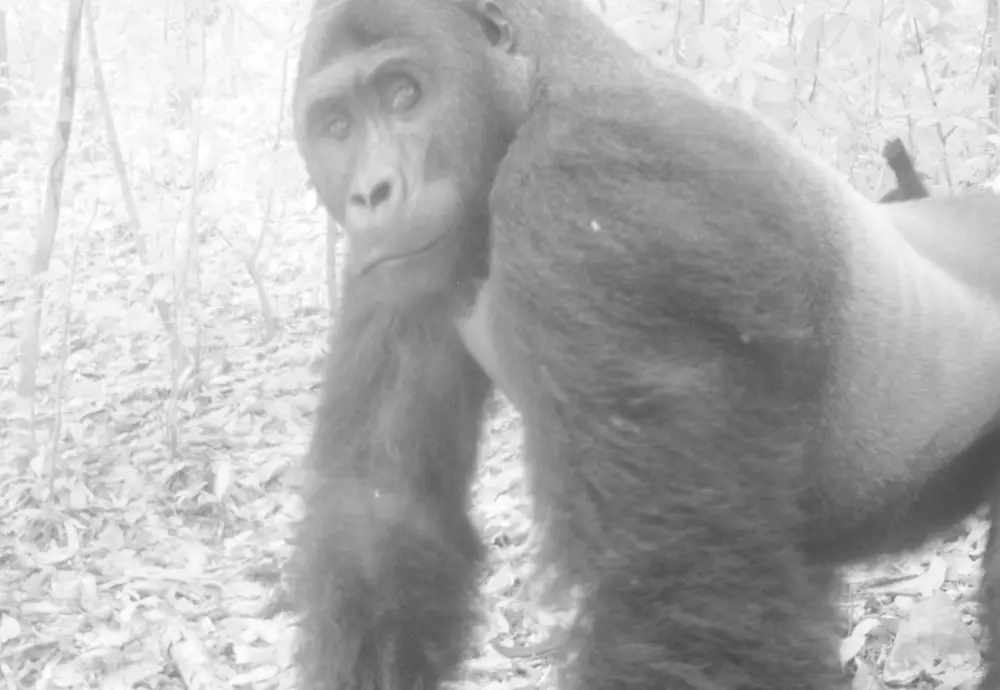
Photos taken by remote cameras allow us to see the gorillas without disturbing them.
The Grauer’s groups we now know
We have been following three groups consistently since 2012. They are called Mbobi, Membe and Odafika, named after the local areas where they range.
Over the years, the nest counts for these groups have changed slightly, which is normal in gorilla populations as births, deaths and transfers occur. But in general, these group populations have remained quite stable.
The Mbobi group usually includes 20 to 23 individuals, with the Membe group containing 18 to 20 members. The Odafika group is particularly impressive with an estimated size of 35 to 42 gorillas. The large size of Odafika helps us recognize it more easily from its nest sites, while the other groups require more careful confirmation.
Since 2020, we have expanded our monitoring to include two additional groups that live closer to one another and whose home ranges often overlap. These groups are called Idumba and Inamahasa. Idumba consistently includes around 14 individuals, while Inamahasa appears to have nine or 10.
What we’ve learned
Although we cannot observe individual social relationships, we are learning a great deal about the gorillas’ ecology, including valuable information about their movements, diet and nesting behavior.
All the groups we monitor contain a single adult male, or silverback. This pattern is consistent with what we know from many populations of lowland gorillas, whereas mountain gorillas often live in multi-male groups.
Their diet is diverse. Grauer’s gorillas feed on herbaceous vegetation found on the forest floor, but they also rely heavily on fruits and leaves from trees. They are strong climbers and can move high into the canopy to feed or to build nests.
They also occasionally eat ants and termites. Trackers can often recognize this behavior from the traces left behind, such as broken termite mounds or disturbed underground ant nests.
Fruit availability appears to play an important role in their movements, and the groups move through the forest following seasonal fruiting patterns. At the same time, the presence of herbaceous vegetation on the forest floor provides a more stable food source throughout the year.
Because fruit resources are more scattered and have seasonal productivity, Grauer’s gorillas travel longer distances than mountain gorillas, whose diets rarely rely on fruits. In Nkuba, the home ranges of the monitored groups vary each month, from about 8 square kilometers up to as much as 35 square kilometers per month. Interestingly, the smallest of the monitored groups, Inamahaza, has the largest variation and also the largest home range size.
Apart from the search for fruits, the Grauer’s groups’ movements also seem to be influenced by the presence of neighboring groups. We observe large overlaps in the areas they use, particularly with the Idumba and Inamahasa groups. But we have rarely seen evidence of interactions, suggesting that groups may try to avoid one another. It appears that the smaller Inamahasa group tends to move away from the larger Idumba group, which justifies the larger area used.
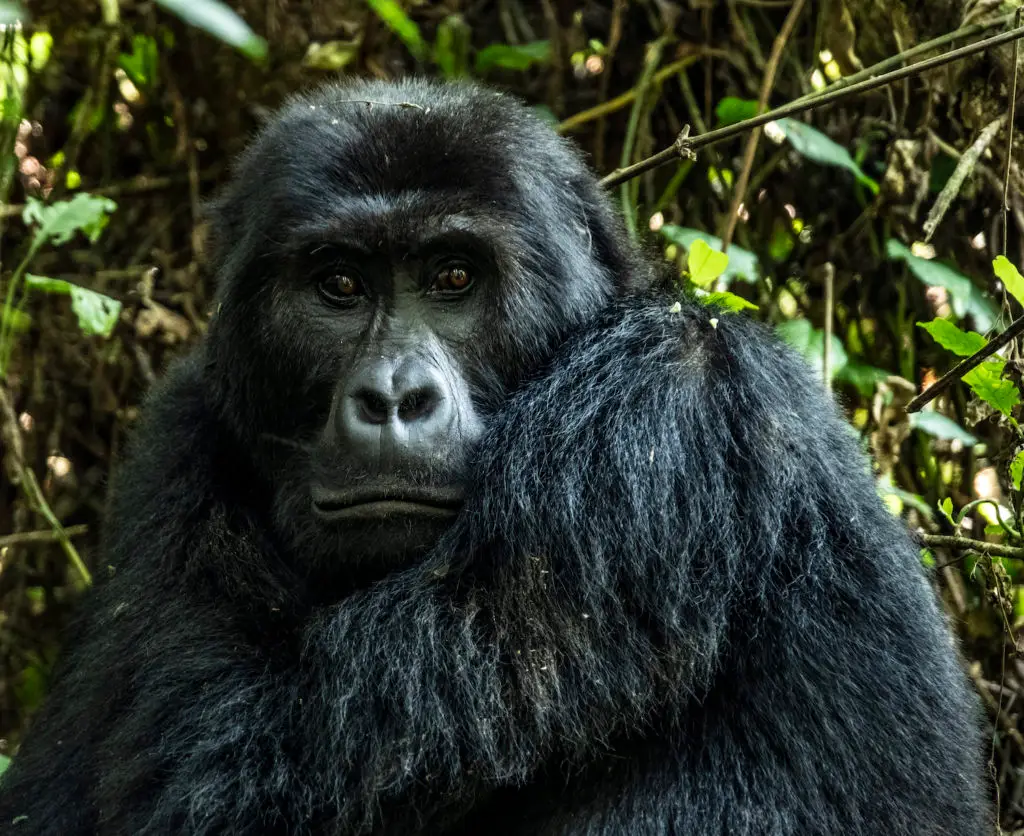
Grauer’s gorillas have been much less studied than mountain gorillas, but we are learning more every day through our tracking in the Nkuba Conservation Area.
Nkuba groups add to basic knowledge
Outside Nkuba, Grauer’s gorillas have been studied mainly in Kahuzi-Biega National Park, where the monitored groups live at higher elevations. The Nkuba population therefore offers a rare opportunity to study this subspecies in a lower elevation forest.
Every new trace, nest site and camera image helps us learn more about these elusive gorillas. Step by step we are revealing the lives of groups that until recently were almost completely unknown.
This article is presented by the Fossey Fund’s gorilla program Senior Advisor, Veronica Vecellio. Veronica has worked with gorillas for more than 20 years and shares her deep knowledge and insights about their lives.


