
Every two years, the International Primatological Society (IPS) convenes hundreds of scientists from around the world to review the status of primate research and conservation, and to publish a list of what are considered to be the world’s 25-most threatened primates. This approach focuses attention toward species at the highest risk of extinction and encourages strategic action and intervention to help protect them.
Among the four types of gorillas, three are critically endangered due to small or dwindling populations and other threats, while only one – the mountain gorilla – has seen increases in population due to intensive daily protection, such as that provided by the Dian Fossey Gorilla Fund and local park authorities.
In July, the critically endangered Grauer’s gorilla – found only in the Democratic Republic of the Congo – was moved by IPS onto the most-endangered list, as the subspecies has faced rapid declines, losing as much as 60% of its population over past decades and living within volatile areas that have long been subject to civil unrest and war, mining, hunting, forest degradation and other dangers.
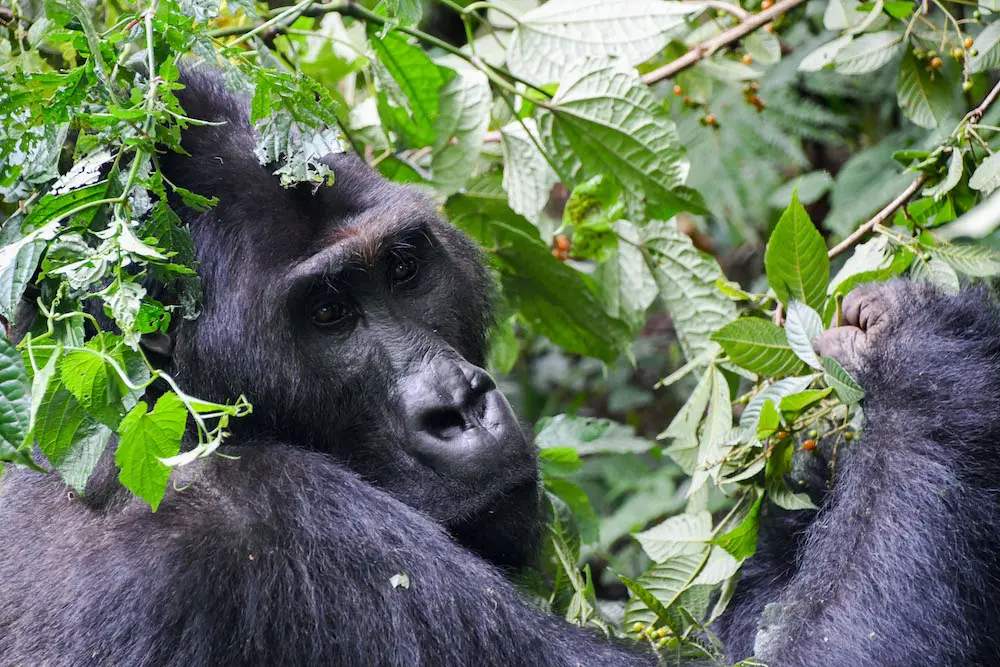
Critically endangered Grauer’s gorillas are found only in the Democratic Republic of the Congo.
Fossey Fund protects Grauer’s gorillas
The Dian Fossey Gorilla Fund has been working to protect Grauer’s gorillas in eastern DR Congo for 25 years, in a 2,400-square-kilometer area of community-managed forests that we helped establish – the Nkuba Conservation Area (NCA). Now designated as a Key Biodiversity Area by the International Union for Conservation of Nature, the NCA protects an estimated 2,000-3,000 Grauer’s gorillas, as well as other endangered and globally threatened species.
“We hope this inclusion of Grauer’s gorillas on the latest most-endangered primates list brings increased attention and visibility to all those – especially our Congolese community conservationists – who are working to protect them despite extreme conditions and challenges,” says Dr. Tara Stoinski, president & CEO/chief scientific officer of the Dian Fossey Gorilla Fund. “In addition, further protecting Grauer’s gorillas helps bring awareness and support to all of the other threatened species in the region, as well as the critical primary forests in which they live.”
“I was glad of this vote, but it was with pain and sorrow in my heart that I had to plead for the Grauer’s gorilla to remain on this highly endangered species list, that we have not yet been able to achieve greater success for them,” says Urbain Ngobobo, our director of programs in the DR Congo and the lead spokesperson advocating for Grauer’s to be on this list.
“However, I’m pleased that the world has come to understand that mobilization to eradicate or reduce the threat to this subspecies is crucial. Now we have to focus on the goal of eventually removing Grauer’s gorillas from this grim list. It’s possible, it’s not an unfounded dream. I hope that the success of the Nkuba Conservation Area will inspire other stakeholders to emulate this community-managed model in their respective areas, thereby extending the regions and groups of gorillas that are truly protected.”


