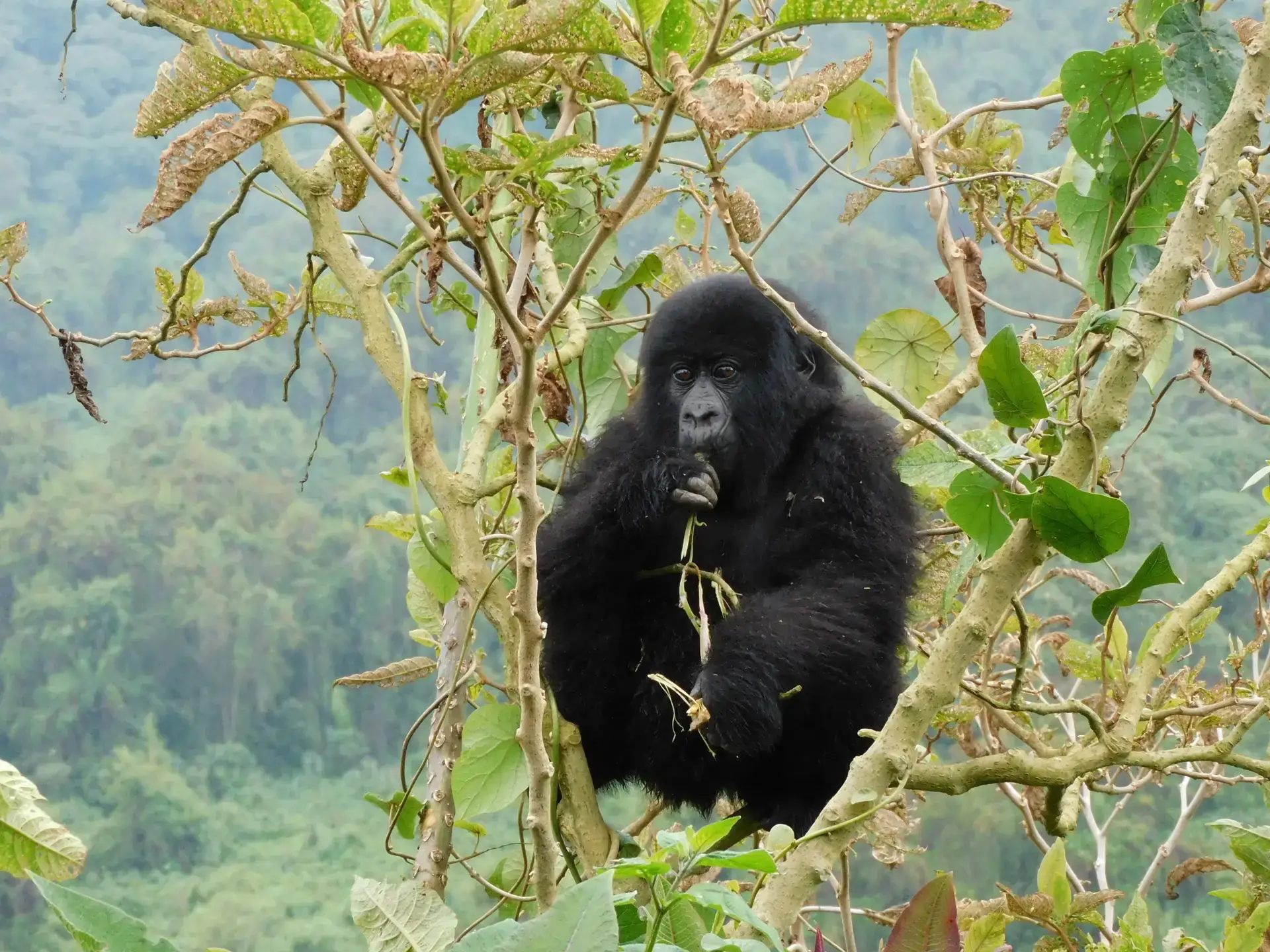
Gorillas are vegetarians and spend their days eating a wide variety of plants, from wild celery to thistles and bamboo shoots, depending on their locations in the forest and the seasons. As they grow, gorillas learn how to carefully manipulate each type of plant to get to the most nutritious and edible parts.
This knowledge and these skills are especially important when it comes to one staple in their diet – stinging nettles. These plants have specialized stiff hairs – called trichomes – which not only can penetrate an animal’s skin but also can contain several chemicals that cause additional pain and irritation.
But gorillas are intelligent and have developed precise techniques to cope with these stinging plants, finding ways to eat the good parts without injury. A new research study published in the journal Ecology and Evolution and led by one of our former Rwandan college students – Alphonse Nyandwi – as well as Fossey Fund scientists and partners, took an up-close look at how the gorillas do this and how it affects the plants as well.

Stinging nettles are a staple food for the mountain gorillas, but it takes special skills to eat them safely.
“I didn’t exactly choose stinging nettles – they chose me,” explains Nyandwi. “I had a personal history with some of these nettles from childhood, when I was often stung. So when this opportunity came, it felt like a natural fit: a way to better understand this plant that once hurt me and, at the same time, its deep connection to gorillas, one of my favorite animals.”
Nyanwdi also says he always had a connection and passion for botany, and when he was selected through the University of Rwanda to conduct his senior thesis with the Fossey Fund, it gave him the chance to connect this passion with gorilla research.
Key food, complex techniques
Although the mountain gorillas in Volcanoes National Park consume parts of at least 200 plant species, they rely heavily on a much smaller group of key foods, and in some areas, types of stinging nettles make up an important part of their diet. So it is not surprising that gorillas – using their intelligence, dexterity and adaptability – have developed complex techniques for eating these and other plants.
With plants like the nettles, they strip leaves upward and fold them, in this case reducing their exposure to the areas that have the most stinging trichomes. And in one type of stinging nettle they eat only the roots, avoiding the difficult above-ground portion that is particularly unpleasant.
However, plants are adaptable too, and this study highlights a co-evolutionary relationship between the stinging nettles and herbivores like the gorillas, meaning that what the gorillas do to get around the plant’s stinging parts can influence the formation of the plants’ defenses over the long term. In other words, both gorillas and plants adapt and co-evolve, each in their own way.
Challenges and learning opportunities
Even though he had a lot of support and mentorship, Nyandwi says the research was not without challenges. “One of the first hurdles was learning to identify different nettle species and knowing which ones sting. Unlike gorillas – the real nettle experts – I had no harvesting skills and got stung many times. Still, I kept going back the next day… I also got to observe gorilla behavior closely, and even tried eating (cooked) nettles myself, surprisingly delicious!”
“Both gorillas and humans have included nettles in their diets,” says coauthor Dr. Melanie DeVore, a professor at Georgia College and State University who focuses on paleobotany and helped launch the study. “Indigenous people throughout the world have used stinging nettles for food, medicinal and ceremonial purposes. The ability of gorillas to recognize and co-evolve behavior to circumvent stinging trichomes is fascinating. This one study opens the doors to exploring more aspects of the gorilla-nettle interaction.
“When I visited the gorillas for the first time … I was stunned, from my perspective as a botanist, how gorillas seemed to have their own deep knowledge of plants and could identify and use the flora, just like us,” DeVore adds.
Looking ahead, Nyandwi says he hopes to continue learning from nature by studying how plants shape ecosystems and the species that depend on them. “I want to keep asking: who will ultimately ‘win’ the battle between gorillas and stinging nettles – or will it always be a kind of win-win co-evolution? That’s the mystery I’d love to keep exploring. At the same time, I want to help train and inspire the next generation of African researchers, just as I was supported through this program.”
Lead study author Alphonse Nyandwi was one of hundreds of Rwandan university students who study with us each year as they prepare for careers in science and conservation. Nyandwi is now pursuing his Ph.D. at the University of Quebec. This study was supported by the Cleveland Metroparks Zoo, which also helped provide training in research skills. Other participants included Fossey Fund scientists, the University of Rwanda, and Georgia College and State University. The Rwanda Development Board and the Volcanoes National Park authorities were also instrumental in supporting this project.